Schottenbauer Publishing

Wednesday, October 14, 2015

Affordable Synthetic Ice for Home Practice


The location and cost of ice rinks is often a limiting factor for families interested in recreational skating. Fortunately, several low-cost options are available for both ice hockey and figure skaters.

Shooting Boards

Starting at less than $100, it is possible to purchase various types of hockey shooting pads. These are plastic boards which can be used for practicing puck handling techniques, but not skating. These boards, approximately 2 to 4 feet wide and 4 to 8 feet long, are available from a variety of manufacturers and stores.

HDPE, US Plastic Corporation

High Density Polyethylene (HDPE) is an affordable plastic which can be purchased directly from a manufacturing company, starting at only $2 to $3 per square foot. As a low-glide surface, it is suitable for ice hockey practice and some basic figure skating. A demonstration video available on YouTube shows the use of two HDPE sheets, each 4 x 8 feet and 3/16 inches thick, from US Plastics Corporation. In February 2014, these two sheets cost only $140, plus a $140 freight shipping charge! Placed side by side, these two sheets make a rink 8 feet by 8 feet.


UHDPE, Direct Import from China
The next best surface is Ultra-High Density Polyethylene (UHDPE), which is commonly used at commercial synthetic ice rinks. These are available from various companies in the USA and abroad, but the best value can be imported direct from China. According to a February 2015 estimate, an Olympic-sized synthetic ice rink (100 ft x 200 ft UHDPE) with sideboards is available for only $22,000, including shipping to East Coast USA! (Import tax and transportation from seaport were not included in this estimate.)

Recycled Plastic, Budget Ice from Canada
One of the lowest-cost synthetic rinks in North America is a recycled plastic surface available from Canada. A small sample is available for only $208 plus tax and shipping, according to an estimate in October 2015.

Sinter-Pressed, SmartRink from Canada
One of the highest-quality synthetic ice consists of sinter-pressed materials, which are reported not to flake or scratch like other brands. This surface is available from Canada, as well as some US warehouse locations.

Buildings
Ice rinks can range from a recreation-room or basement model  (e.g., 8' x 8') to a full Olympic sized rink. Although outdoor rinks offer a lower cost and the ambiance of outdoors, indoor rinks have many additional benefits. For instance, indoor rinks allow for more flexibility of use, such as skating at night and during bad weather, as well as protection from leaves and organic matter. Some of the most common buildings used for ice rinks include tension fabric structures, steel structures, and pole barns. These options are available at ultra low-cost from China, with prices as low as $3 per square foot, compared to US models from $9 per square foot or more! Some companies also offer free installation options.


Additional Information

Tuesday, October 6, 2015

The Physics of Spins

Acceleration is an important feature of all ice skating. The same as with motion, acceleration can be translational (in a straight line), or rotational (in a circle). If acceleration is rotational, then it is in an axial direction, pointing inward to the center of the circle of motion. This form of acceleration is called centripetal acceleration.

Consider the following graph, excerpted from The Science of Ice Skating: Volume 3 from Schottenbauer PublishingThe graph shows acceleration during a figure skating spin.


Discussion Questions
  1. Initially, which direction is vertical or nearly vertical?
  2. At the end, which direction is vertical or nearly vertical?
  3. Describe the relationship between the initial and final angles of the foot in relation to the floor.
  4. Is it possible to identify how many revolutions are present? If so, how many? If not, why?
  5. Is it possible to determine whether this is a slow or fast spin? If so, which is it?
  6. What is the initial velocity? The final velocity?
  7. What is most likely the cause of the spikes in the graph?

Additional free graphs are available in a free pamphlet from the publisher's webpage. 

The following books from Schottenbauer Publishing contain similar types of graphs and data pertaining to the science of ice skating, figure skating, and hockey:

Graphs & Data for Science Lab: Multi-Volume Series
  • The Science of Ice Skating 
    • Volume 1: Translational Motion
    • Volume 2: Rotational Motion (Curves)
    • Volume 3: Rotational Motion (Spins)
    • Volume 4: Jumps
    • Volume 5: Ice Hockey
    • Volume 6: Biophysics
    • Volume 7: Video Analysis
    • Volume 8: Reference Manual
  • The Science of Hockey
    • Volume 1: Force, Acceleration, & Video Analysis of Pucks & Balls
    • Volume 2: Force & Acceleration of Sticks, plus Biophysics
    • Volume 3: Video Analysis of Ice, Field, & Street Hockey Sticks
    Anthologies of 28 Graphs
      • The Science of Figure Skating
      • The Science of Ice Hockey
      • The Science of Winter Olympic Sports


      Saturday, September 5, 2015

      Comparing Real & Synthetic Ice

      Synthetic ice is a popular, low-cost alternative to real ice rinks. Available in several forms and quality levels, synthetic ice usually consists of a slippery plastic surface which mimics the performance of real ice. 

      How good is synthetic ice? The following graphs, excerpted from Glide, Spin, & Jump: The Science of Ice Skating: Volume 1: Extended Edition, compare the performance of a sharpened figure skate on real ice and HDPE synthetic ice.


      Discussion Questions
      1. Compare the force line in each graph, using words. What is one major qualitative difference between the graphs? 
      2. In the second graph, what is the minimum force? Is the real force ever less than 0? Why or why not? 
      3. Why is force applied before the skate moves? Does this force contribute to velocity? At what point does force contribute to acceleration and velocity? 
      4. In the first graph, what is the maximum force? The maximum position? Velocity? Acceleration? 
      5. In the second graph, what is the maximum force? The maximum position? Velocity? Acceleration? 
      6. In each graph, calculate the range of time in which skate movement occurs. Which is larger?
      7. The second graph claims that the skate has been pulled 1 meter. What is the evidence for or against this assertion? (Hint: How long is the skate?) 
      8. What force is required to pull the skate 1 meter on synthetic ice? On real ice? Which force is larger?


      The following books from Schottenbauer Publishing contain similar types of graphs and data pertaining to the science of ice skating, figure skating, and hockey:

      • The Science of Ice Skating 
        • Volume 1: Translational Motion
        • Volume 2: Rotational Motion (Curves)
        • Volume 3: Rotational Motion (Spins)
        • Volume 4: Jumps
        • Volume 5: Ice Hockey
        • Volume 6: Biophysics
        • Volume 7: Video Analysis
        • Volume 8: Reference Manual
      • The Science of Hockey
        • Volume 1: Force, Acceleration, & Video Analysis of Pucks & Balls
        • Volume 2: Force & Acceleration of Sticks, plus Biophysics
        • Volume 3: Video Analysis of Ice, Field, & Street Hockey Sticks
        • The Science of Figure Skating
        • The Science of Ice Hockey
        • The Science of Winter Olympic Sports

        In addition, the following books are suitable for younger children learning geometry:

        • The Geometry of Figure Skating
        • The Geometry of Winter Olympic Sports 


        A simple demonstration of one type of synthetic ice is available below, in the YouTube video My First Ice Rink. This synthetic ice consists of High Density Polyethylene (HDPE), one of the least expensive surfaces manufactured in the USA. In fact, 3/16" x 48" x 96" HDPE sheets from US Plastics Corporation sold for approximately $2 per square foot in 2014. 


        While high-quality synthetic ice may cost $16 per square foot or more, one variety of Ultra-High Density Polyethlene (UHDPE) is available low-cost from Dezhou Shengtong Rubber & Plastic Co., Ltd. in China. According to price estimates in February 2015, an Olympic-sized synthetic ice rink (100x200 ft, UHDPE with sideboards) is available from China to East Coast USA w/shipping (not including import tax) for only $22,000! 

        Additional videos demonstrating HDPE synthetic ice are available on the Skating Science Playlist.


        Friday, June 12, 2015

        Sliding on Ice: The Case of Two Hockey Pucks

        The concept of friction is essential to all skating on ice, whether it is for hockey, speed, or figure skating. Ice provides a reduced-friction surface, which allows humans to glide, rather than stick to the floor. Synthetic ice, consisting of slippery plastic, also reduces friction. The friction of synthetic ice can be lowered further by applying soapwater, or other slippery liquids.

        For gliding motion to occur, two types of friction must be overcome: initial non-moving (static) friction, and moving (kinetic) friction.

        The following graphs, excerpted from Volume 1 of The Science of Hockey, show the effect of force on motion of an official hockey puck.


        Discussion Questions
        1. Describe the magnitude of each force in Graph 1. For what amount of time is each force applied?
        2. Describe the motion of the puck in Graph 2, using words.
        3. How far does the puck travel? In what direction?
        4. Are the graphs coordinated in the time dimension?


        The following graphs, excerpted from Volume 1 of The Science of Hockey, compare the force required to move two types of pucks on synthetic ice (HDPE plastic).


        Discussion Questions
        1. Is the total force different in these two graphs? If so, why?
        2. Is the initial force different in these two graphs? If so, why?
        3. What is the average force is applied to each puck?
        4. Calculate the work involved for each puck.
        5. Why does the practice hockey puck perform differently on synthetic ice than an official puck? (Hint: The practice hockey puck is normally used on concrete floors.)

        Additional free graphs on the science of ice skating are available in a free pamphlet from the publisher's webpage. 

        The following books from Schottenbauer Publishing contain similar types of graphs and data pertaining to the science of ice skating, figure skating, and hockey:

        Graphs & Data for Science Lab: Multi-Volume Series
        • The Science of Ice Skating 
          • Volume 1: Translational Motion
          • Volume 2: Rotational Motion (Curves)
          • Volume 3: Rotational Motion (Spins)
          • Volume 4: Jumps
          • Volume 5: Ice Hockey
          • Volume 6: Biophysics
          • Volume 7: Video Analysis
          • Volume 8: Reference Manual
        • The Science of Hockey
          • Volume 1: Force, Acceleration, & Video Analysis of Pucks & Balls
          • Volume 2: Force & Acceleration of Sticks, plus Biophysics
          • Volume 3: Video Analysis of Ice, Field, & Street Hockey Sticks
        Anthologies of 28 Graphs
          • The Science of Figure Skating
          • The Science of Ice Hockey
          • The Science of Winter Olympic Sports

          In addition, the following books are suitable for younger children learning geometry:

          • The Geometry of Figure Skating
          • The Geometry of Winter Olympic Sports 

          The Science of Jumping

          What happens when an ice skater jumps? The answer can be modeled in various levels of difficulty. One the simplest level, assume that the skater is simply a point mass object, without movement within the body. In this analysis, acceleration occurs in three planes, leading to changes in altitude and rotation. 


          On the most complex level, the skater's body must be analysed as separate components moving in relation to the center of mass, which for most humans is approximately in the center of the abdomen or hips.


          Discussion Questions
          1. What everyday motions are related to skating? 
          2. If skater motion were to be studied by making comparisons between graphs, which types of motions should be compared?

          Volume 4 of Glide, Spin, & Jump: The Science of Ice Skating contains graphs of acceleration, force, and vertical distance in a series of motions completed by the author. 

          Graphs of Motion
          • Standing to Squatting Position
          • Jumping with No Rotation
          • Rotation with No Jumping
          • Skating Jumps on Land
          • Skating Jump on Synthetic Ice

          Jumps on Land
          • Half Jumps
            • Stag
            • Waltz
            • Ballet 
            • Mazurka
            • Half Axel
          • Single & Double Jumps
            • Salchow
            • Loop
            • Toe Loop
            • Flip
            • Lutz
            • Axel

          The following two graphs are excerpted from Volume 4 of Glide, Spin, & Jump: The Science of Ice SkatingNotice that these jumps, completed in a purely vertical direction on land, are simpler to analyze, because they lack the horizontal translational motion across the ice. 


          Discussion Questions
          1. What are the major differences between these graphs?
          2. In these graphs, how can direction be determined? What direction is up?
          3. In each graph, what occurs in the vertical direction? 
          4. In the lower graph, what is the pattern of acceleration in the horizontal plane during the rotations?
          5. In each graph, what sort of tilt (side to side) occurs?
          6. Is it better to locate the wireless device on the stomach or chest? Why?
          7. Describe the role of knee motions during each of the above jumps, and their effects on acceleration.
          8. What is the role of non-relevant movements (such as the motion of breathing) in these graphs, if any?
          9. What is the role of error or random motion in these graphs, if any? 
          10. Are these clean (technically correct) jumps? If not, what would the acceleration pattern be during a clean jump?
          11. What would a fall look like in a graph of acceleration?
          12. What would the graphs look like if the jumps were completed on the ice?

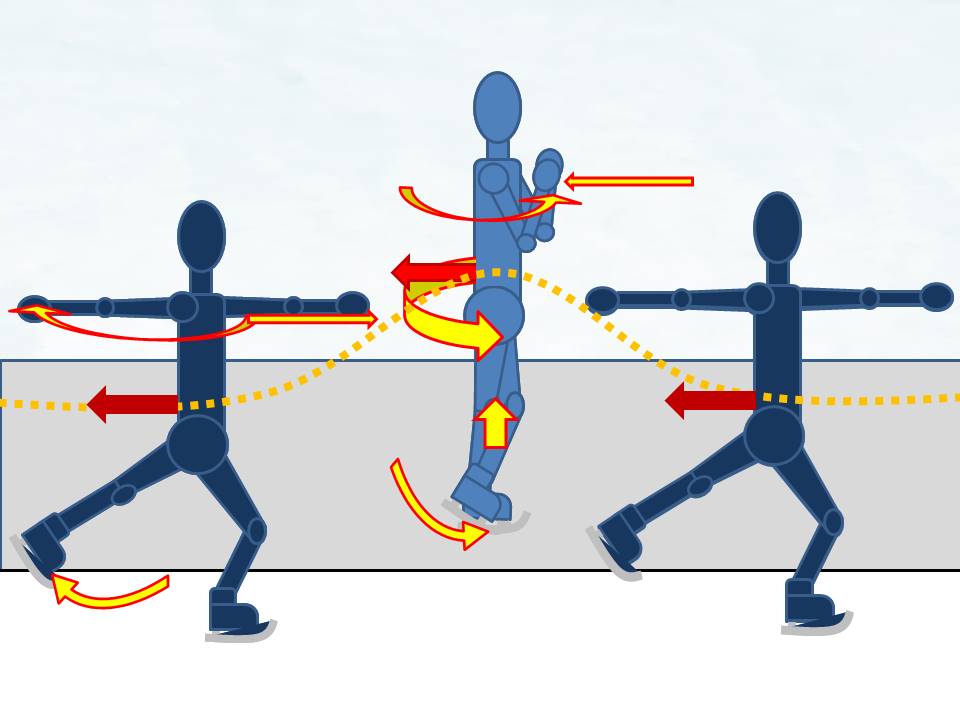
          Additional free graphs of ice skating are available in a free pamphlet from the publisher's webpage. A humorous cartoon animation of an ice skater, showing approximate force vectors, is available from the publisher's YouTube channel.


          The following books from Schottenbauer Publishing contain similar types of graphs and data pertaining to the science of ice skating, figure skating, and hockey:

          Graphs & Data for Science Lab: Multi-Volume Series
          • The Science of Ice Skating 
            • Volume 1: Translational Motion
            • Volume 2: Rotational Motion (Curves)
            • Volume 3: Rotational Motion (Spins)
            • Volume 4: Jumps
            • Volume 5: Ice Hockey
            • Volume 6: Biophysics
            • Volume 7: Video Analysis
            • Volume 8: Reference Manual
          • The Science of Hockey
            • Volume 1: Force, Acceleration, & Video Analysis of Pucks & Balls
            • Volume 2: Force & Acceleration of Sticks, plus Biophysics
            • Volume 3: Video Analysis of Ice, Field, & Street Hockey Sticks
          Anthologies of 28 Graphs
            • The Science of Figure Skating
            • The Science of Ice Hockey
            • The Science of Winter Olympic Sports

            In addition, the following books are suitable for younger children learning geometry:

            • The Geometry of Figure Skating
            • The Geometry of Winter Olympic Sports 

            Sunday, April 5, 2015

            How Does Geometry Affect Ice Skating?

            On the surface level, both the technique and beauty of ice skating can be described by geometry, in terms of the angles of knee bends and arm positions. On a technical level, geometry is essential for understanding the science of ice skating, including the physics of force and motion.

            The books The Geometry of Winter Olympic Sports and The Geometry of Figure Skating contain diagrams which introduce children and teens to the task of identifying angles in ice skating. Consider the diagram below, excerpted from page 25 of The Geometry of Winter Olympic Sports (Copyright 2014, All Rights Reserved).

            Discussion Questions
            1. How many angles are formed in this diagram?
            2. From a casual analysis, what types of angles (Acute/Obtuse/Right) are located in the diagram? Indicate the location of each angle.
            3. In order to analyze the angles in this diagram, where should the coordinate axis be placed? Why? Is it necessary to identify more than one coordinate axis? Why or why not? If so, where should the axes be placed?
            4. Using a protractor, measure all the angles in the diagram that are relevant to the art or physics of skating.
            5. Is it possible to identify the direction of motion from this diagram? Why or why not?
            6. Is this a figure skater or a hockey player? Justify your answer.

            Assistance answering some of these questions may be found by watching the video How to Use Geometry Workbooks on the publisher's YouTube channel.

            The following books from Schottenbauer Publishing contain geometry diagrams relevant to ice skating, figure skating, and hockey. 


            • The Geometry of Figure Skating
            • The Geometry of Winter Olympic Sports 

            Monday, November 3, 2014

            Skater in Motion: x-y Plots of Movement

            In elementary school, math students learn the graph-reading skills. How often do these same students enjoy applying math to real-life data? In books from Schottenbauer Publishing, students have the opportunity to decode graphs showing movement during popular sports.

            The graph below (Copyright 2014, All Rights Reserved), excerpted from the book series Glide, Spin, & Jump: The Science of Ice Skating from Schottenbauer Publishing, shows an ice skater in forward motion.


            Discussion Questions
            1. What is the range of each variable in each graph? Include x, y, and t as variables in your analysis.
            2. In this sample, which leg is used for pushing off? Which leg moves forward first? 
            3. Use the information from the graph to draw the body in physical space, at a minimum of 4 time points.
            4. Is the right knee ever in front of the right hip? Is the right ankle ever in front of the right knee or right hip? Describe the sequence of motion.
            5. Is the left knee ever in front of the left hip? Is the left ankle ever in front of the left knee or left hip? Describe the sequence of motion.

            Additional free graphs are available in a free pamphlet from the publisher's webpage. 

            The following books from Schottenbauer Publishing contain similar types of graphs and data pertaining to the science of ice skating, figure skating, and hockey:

            Graphs & Data for Science Lab: Multi-Volume Series
            • The Science of Ice Skating 
              • Volume 1: Translational Motion
              • Volume 2: Rotational Motion (Curves)
              • Volume 3: Rotational Motion (Spins)
              • Volume 4: Jumps
              • Volume 5: Ice Hockey
              • Volume 6: Biophysics
              • Volume 7: Video Analysis
              • Volume 8: Reference Manual
            • The Science of Hockey
              • Volume 1: Force, Acceleration, & Video Analysis of Pucks & Balls
              • Volume 2: Force & Acceleration of Sticks, plus Biophysics
              • Volume 3: Video Analysis of Ice, Field, & Street Hockey Sticks
            Anthologies of 28 Graphs
              • The Science of Figure Skating
              • The Science of Ice Hockey
              • The Science of Winter Olympic Sports

              In addition, the following books are suitable for younger children learning geometry:

              • The Geometry of Figure Skating
              • The Geometry of Winter Olympic Sports 

              Thursday, October 2, 2014

              Pucks & Balls: The Physics of Motion

              How does a ice hockey puck compare to a field hockey ball? This question is highly relevant for ice hockey players, who are eager to keep in shape over the warm summer months. According to physics, balls do not act like pucks. The graphs below (Copyright 2014, All Rights Reserved), excerpted from the book series The Science of Hockey from Schottenbauer Publishing, show an official field hockey ball and an official ice hockey puck in motion.


              Discussion Questions
              1. What is the range of each variable in each graph? Include x, y, and t as variables in your analysis.
              2. Use the information from the graph to draw the trajectory of the ball and the puck on separate pieces of paper. Include beginning and ending time points in your drawing.
              3. Using the information from Questions 1 and 2, compare the graphs. What is different about the motion of the ball and the puck?
              4. Approximately how much energy from the ball is lost due to friction? 
              5. Approximately how much energy from the puck is lost due to friction? 

              Additional free graphs are available in a free pamphlet from the publisher's webpage. 

              The following books from Schottenbauer Publishing contain similar types of graphs and data pertaining to the science of ice skating, figure skating, and hockey:

              Graphs & Data for Science Lab: Multi-Volume Series
              • The Science of Ice Skating 
                • Volume 1: Translational Motion
                • Volume 2: Rotational Motion (Curves)
                • Volume 3: Rotational Motion (Spins)
                • Volume 4: Jumps
                • Volume 5: Ice Hockey
                • Volume 6: Biophysics
                • Volume 7: Video Analysis
                • Volume 8: Reference Manual
              • The Science of Hockey
                • Volume 1: Force, Acceleration, & Video Analysis of Pucks & Balls
                • Volume 2: Force & Acceleration of Sticks, plus Biophysics
                • Volume 3: Video Analysis of Ice, Field, & Street Hockey Sticks
              Anthologies of 28 Graphs
                • The Science of Figure Skating
                • The Science of Ice Hockey
                • The Science of Winter Olympic Sports

                Spinning on Ice

                Physics divides motion into two general types: translational (straight) motion and rotational (curved) motion. Whether it is a figure skater, hockey skater, or puck rotating on the ice, the same laws of physics apply. 

                The graph below (Copyright 2014, All Rights Reserved), excerpted from the book series Glide, Spin, & Jump: The Science of Ice Skating from Schottenbauer Publishing, shows a rod rotating around a central axis.


                Discussion Questions
                1. Describe the four variables contained in the graph. What is the range of each variable?
                2. How is position measured in the graph? What is the unit of measurement?
                3. How many times is force applied to the rod? 
                4. When force is applied, what happens to the rod?
                5. Why does the rod slow down, and motion stop?
                6. What is the definition of acceleration? 
                7. Why does acceleration change so much, when the velocity and position do not?


                Additional free graphs are available in a free pamphlet from the publisher's webpage. 

                The following books from Schottenbauer Publishing contain similar types of graphs and data pertaining to the science of ice skating, figure skating, and hockey:

                Graphs & Data for Science Lab: Multi-Volume Series
                • The Science of Ice Skating 
                  • Volume 1: Translational Motion
                  • Volume 2: Rotational Motion (Curves)
                  • Volume 3: Rotational Motion (Spins)
                  • Volume 4: Jumps
                  • Volume 5: Ice Hockey
                  • Volume 6: Biophysics
                  • Volume 7: Video Analysis
                  • Volume 8: Reference Manual
                • The Science of Hockey
                  • Volume 1: Force, Acceleration, & Video Analysis of Pucks & Balls
                  • Volume 2: Force & Acceleration of Sticks, plus Biophysics
                  • Volume 3: Video Analysis of Ice, Field, & Street Hockey Sticks
                Anthologies of 28 Graphs
                  • The Science of Figure Skating
                  • The Science of Ice Hockey
                  • The Science of Winter Olympic Sports